
Waterbury City Directory Shelves
The Silas Bronson Library holds the central Waterbury city directory run. Its collection starts with 1868–69 and is nearly complete in physical form from 1868 through 1990, with later material in the library collection. Some early pages are missing, though the surviving pages are readable. The shelf, early online scans, and other archives form complementary access channels rather than identical copies.
| Collection | Years | Where held | Access |
|---|---|---|---|
| Bronson physical city directories | 1868–69 through 1990, nearly complete; later holdings | Silas Bronson Library | In person with reference help |
| Bronson early PDF run | 1868–69, 1869, 1871, 1872, 1874, 1875–76, 1876, 1877, 1881 | Bronson website | Free online PDFs |
| United States City and Business Directories | Indexed volumes vary; Waterbury 1962 cataloged | FamilySearch | Search and catalog access vary |
| Business and institutional archives | Collection-specific | Mattatuck Museum Traurig Library | Scheduled archival research |
Price, Lee & Co. appears on the 1881 title material. Do not project that publisher onto every year. Check each title page, record the volume date, and note whether the copy is a scan, physical book, or indexed database.
Open Early Waterbury Directories
The Bronson directory collection links the early scans. Useful starting points include 1868–69, 1872, and the complete 1881 volume. Public-domain treatment is strongest for books published before January 1, 1923. Follow Bronson’s terms for later scans and reproductions.
PDF text search is a first pass. Old type, tight columns, damage, and abbreviations can defeat optical character recognition. Search a surname, inspect nearby pages, and browse the alphabetical range even when the search returns nothing. Save the printed page number and the PDF page position because they may differ.
The source view below comes from the Bronson collection page and confirms the local route to the historic Waterbury city directories.
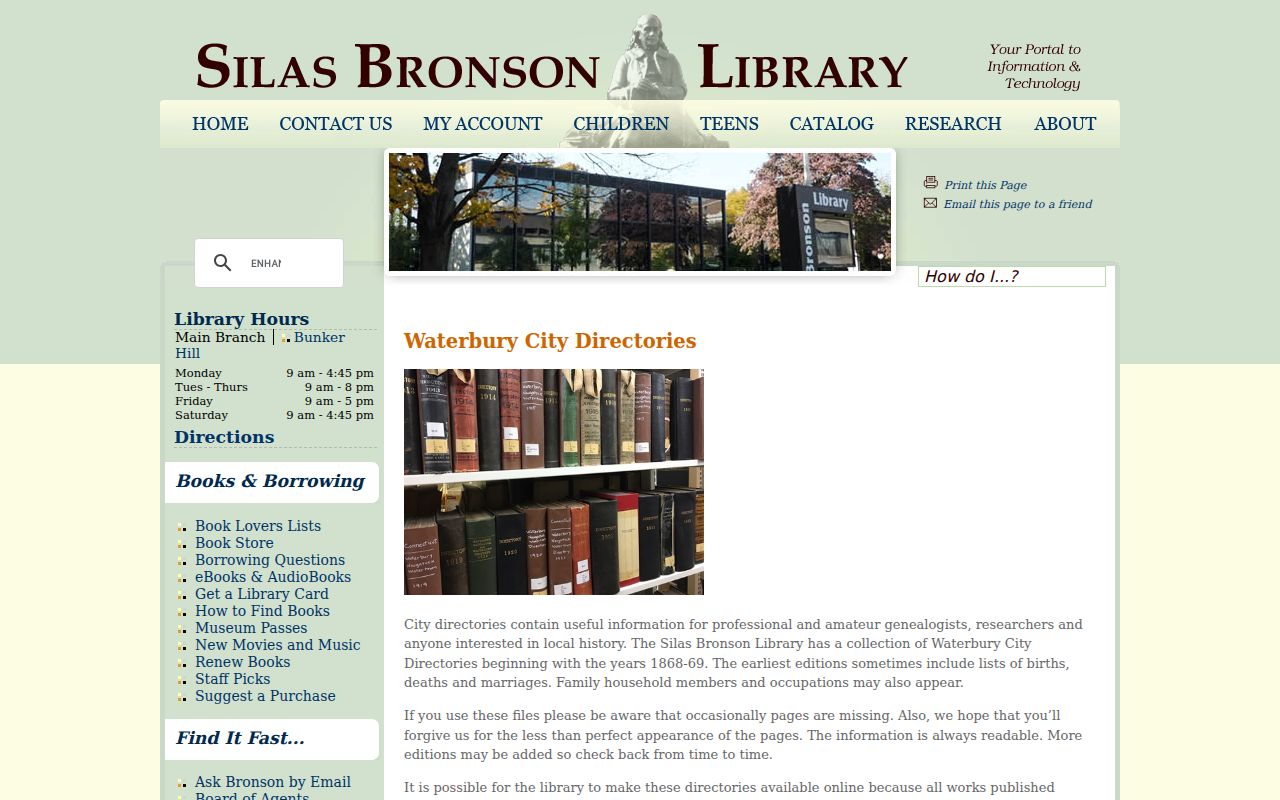
The collection screen should lead to a dated volume, while the physical shelf remains the fallback for gaps or pages that are hard to read online.
Read a Waterbury Directory Entry
The 1872 Waterbury city directory shows why an entry must be copied in full. Warner entries include names, status terms such as “Mrs” or “widow,” a residence mark, and compact street or cross-street notation. The same page mixes residents, workers, professional listings, and firms including Waterbury Brass, Buckle, Button, and Clock companies. A business line is not a home address.
| Name and status | Printed personal name plus terms such as Mrs or widow |
|---|---|
| Work | Occupation, trade, employer, or business reference when printed |
| Residence | Original house, street, and cross-street wording |
| Business entry | Company name or advertisement reference, which may not be residential |
| Source label | Directory year, printed page, digital image, and access date |
Forms such as h Clay, h Willow c Grand, and h Willow n W Main are source text, not modern standardized addresses. Check the volume’s own key before expanding a letter.
- Criss-cross directory
- A later directory or section ordered by street or address instead of surname.
- Householder index
- A name or address list centered on the person under whom a household was printed.
- Abbreviation key
- The volume’s explanation of short forms. Capture it because conventions can change.
Search Waterbury Names Two Ways
A surname hit is only half the search. Copy the whole personal entry, then inspect the street section for the address. The reverse check can expose another listed person, a business, a cross street, or a spelling difference. It can also show that the original search result was a work location rather than a home.
Search the personal and street sections independently. Someone may be absent from one section, printed under another household member, or missed by OCR. Compare at least one volume before and after the target year. A year-to-year shift can mean a move, a numbering change, a changed status, an omission, or a printing error.
Note: Cite the exact Waterbury city directory year and page; never convert a historic listing into a claim of current residence.
Map Waterbury’s 1891 Reset
Waterbury renumbered its streets in 1891 under a system proposed by the city engineer. That local quirk means a number in an early directory cannot be dropped into the modern assessor search. Keep the old number and cross-street wording. Then use the Bronson map guide to compare the 1879, 1896, 1909, and 1932 indexed maps.
Sanborn sheets add building footprints and nearby landmarks. The Library of Congress holds Waterbury sets for 1890 and 1901, while Yale’s guide lists additional years through 1922. Only after the old street context is clear should a current GIS parcel be considered. The modern address-keyed chain belongs on the Waterbury streets page.
Use Bronson’s Waterbury Desk
Bronson’s reference desk is at 267 Grand Street, 203-574-8225, and bronsonlibrary@waterburyct.org. Published hours are Monday 9:00–4:45, Tuesday through Thursday 9:00–8:00, Friday 9:00–5:00, and Saturday 9:00–4:45. Recheck hours before a visit. Two digital microfilm readers can save an image to a thumb drive or send it by email.
The library’s genealogy resources join city directories with newspapers, cemetery material, maps, census sources, vital-record guides, and obituary help. Newspaper microfilm spans several Waterbury titles, including the Waterbury American from 1844 to 1990, Waterbury Republican from 1884 to 1990, and Waterbury Republican-American from 1990 to 2019. Some online newspaper access needs a library card.
If a directory page is missing, bring the name, approximate date, and Waterbury context to the desk. Staff can help move from a directory gap to a newspaper, obituary, map, or another local source.
Extend Waterbury Directory Research
The Mattatuck Museum Traurig Library holds business, institutional, organization, family, ledger, map, photo, and city-directory material. It describes more than 125 archival collections and over 700 linear feet. In-person work is scheduled through archivist Caleb Weissman at 203-753-0381 ext. 119.
This archive is especially helpful when a company advertisement, church, school, neighborhood group, or family vanishes from the city directory trail. It can supply the institutional side of a personal entry without assuming that a named worker lived at the business address. The Connecticut State Library’s genealogy guide adds census, court, probate, cemetery, naturalization, map, and newspaper routes for older cases.
Waterbury Directory Time Markers
Local record events help select the right shelf, map, or newspaper title. They do not prove that any named person took part in an event.
| 1868–69 | Bronson’s first Waterbury city directory volume |
|---|---|
| 1891 | City-engineer street renumbering |
| 1902 | Town and city consolidation, affecting record arrangement |
| 1912 | Old City Hall burned |
| 1915 | Cass Gilbert City Hall was dedicated |
The City Historian supplies the City Hall dates. Phrases such as “old City Hall,” a school name, or a street intersection can improve newspaper searching when a person’s name was misspelled.
Trace Waterbury Families by Year
Waterbury city directories fill the years between federal census schedules. They can track printed address, occupation, status, and business ties, but they are compiled publications rather than sworn registrations.
- Choose a target year and a two- or three-year window. Open the nearest earlier and later volumes.
- Search the surname, then browse nearby pages for OCR misses and spelling variants. Copy the complete entry.
- Search the street section on its own. Preserve the cross street, business reference, and every abbreviation.
- Compare adjacent years and a matching census year. Mark moves, gaps, changed work, and status without assuming why they changed.
- Use Bronson newspapers, obituary help, cemetery records, or Mattatuck files to test what happened after the final listing.
A disappearance can mean a move, death, omission, unlisted status, or a damaged page. State the possibilities until another dated source resolves them. FamilySearch’s United States City and Business Directories can provide another search path; its cataloged 1962 Waterbury suburban volume has 1,018 pages. Verify a key fact against Bronson or another official repository when possible.
Limits of Waterbury City Directories
A city directory can be stale, incomplete, duplicated, or misspelled. “Household” may mean a business or boarding arrangement in the source. A firm address is not necessarily anyone’s residence, and a widow notation should be checked against an obituary or vital source. Later scans and indexed databases may also omit pages present on the Bronson shelf.
Label each finding with year, volume, page, and repository. Quote the original address before offering a cautious modern match. These habits protect the historical value of the record and prevent a directory entry from being stretched beyond what it says.
When the online scan fails, the fallback order is simple: inspect the Bronson physical volume, ask the reference desk about microfilm or a missing page, check Mattatuck for related institutional papers, and use the State Library for wider archival context. No single database replaces that local shelf.